

The Indonesian automotive landscape in 2025 has reached a critical inflection point. While the “headline” numbers might suggest a period of cooling, a deeper dive into the data reveals a sophisticated structural transformation. The industry is rapidly shedding its skin as a high-volume Internal Combustion Engine (ICE) market to become a high-value, technology-driven Indonesia EV ecosystem hub for the Asia-Pacific region.
For global investors and automotive manufacturers, 2025 has been a year of strategic recalibration. As we look at the data and the changing infrastructure, it becomes clear that the next era of Indonesian manufacturing will not be defined by quantity alone, but by the intelligence of the ecosystem supporting it.
The 2025 Market Reality: A Tale of Two Powertrains
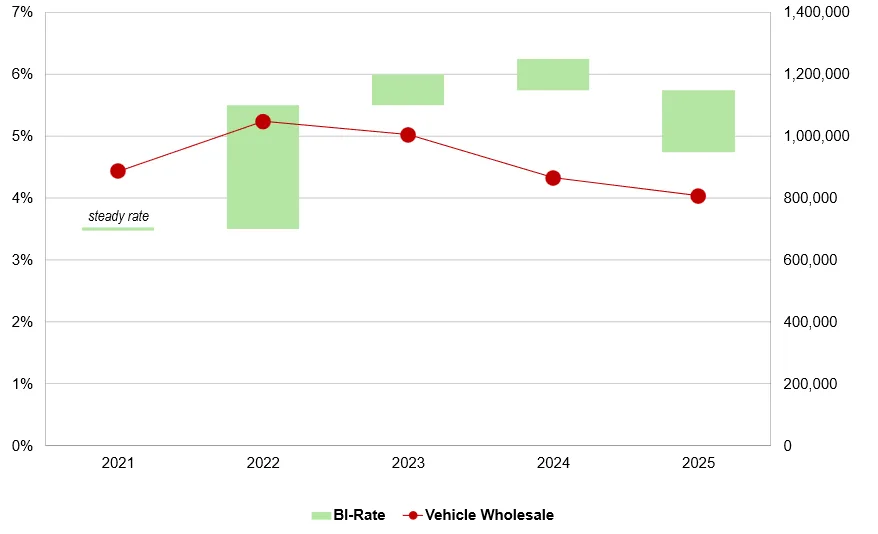
To understand where the industry is heading, one must look at the divergence in wholesale data (factory-to-dealer). According to GAIKINDO, the total wholesale volume for 2025 stabilized at approximately 803,687 units. While this represents a contraction from the 2022 peak of 1.04 million units, the internal composition of these sales has changed dramatically.
- The ICE Contraction: Vehicle wholesale declined to 803,687 units in 2025, down from over 1.05 million in 2022. This is largely due to a “middle-class squeeze” and higher interest rates affecting entry-level buyers.
BANK INDONESIA INTEREST RATE VS. VEHICLE WHOLESALE IN INDONESIA, 2021-2025
Source: Bank Indonesia, GAIKINDO (2026)
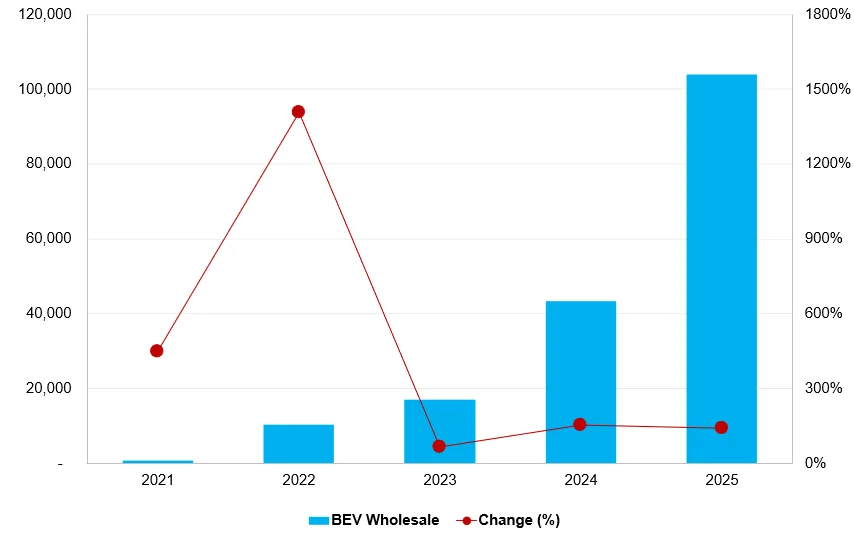
- The EV Surge: Conversely, Battery Electric Vehicles (BEVs) have exploded. Wholesale EV sales reached 104,961 units in 2025—a staggering growth compared to the 10,327 units seen just three years prior.
BATTERY ELECTRIC VEHICLE WHOLESALE IN INDONESIA, 2021-2025
Source: GAIKINDO (2026)
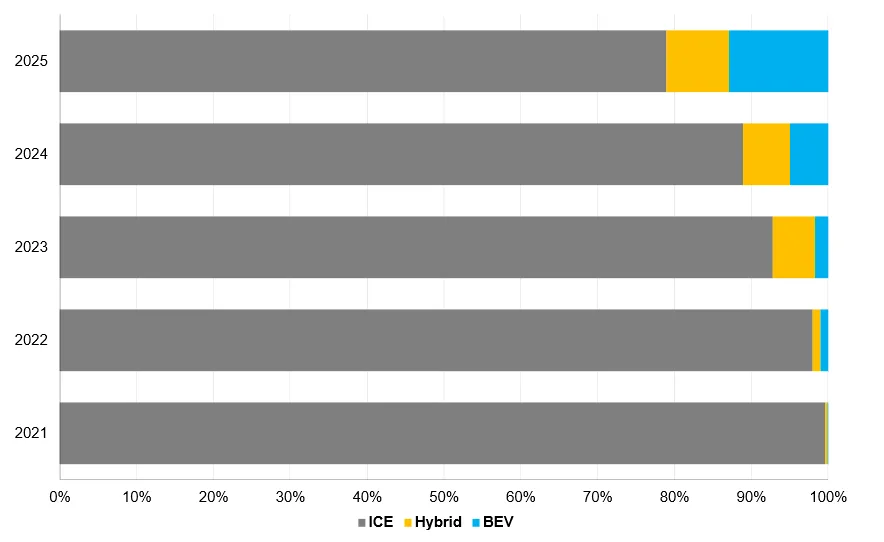
- The Inflection Point: 2025 is the first year where “New Energy Vehicles” (EVs and Hybrids) captured a combined 21% market share of national wholesale volume.
ICE, EV AND BEV WHOLESALE IN INDONESIA, 2021-2025
Source: GAIKINDO (2026)
This data sends a clear signal to manufacturers: the domestic appetite and government policy are no longer supporting the status quo of the last decade. The future is electric, and the infrastructure is finally catching up.
Why Production is Pivoting
The decline in ICE production is not a sign of a failing sector, but a deliberate “retooling” of the nation. Global giants like Hyundai, Wuling, and BYD have transitioned from importing vehicles to full-scale domestic assembly.
The government’s 0% luxury tax (PPnBM) and VAT discounts are now strictly tied to local content requirements (TKDN). This has forced a shift in the industrial center of gravity. Manufacturers are moving away from saturated, older industrial clusters in favor of “Smart” townships that offer the high-tech utilities required for EV battery integration and automated assembly lines.
Subang Smartpolitan: The Anchor of the New Automotive Corridor
As the industry pivots, location has become the ultimate competitive advantage. Subang Smartpolitan, a 2,717-hectare integrated development, has emerged as the premier destination for this new wave of high-tech manufacturing.
It is no coincidence that the world’s leading EV manufacturers have selected Subang Smartpolitan for their flagship facilities. By offering a 5G-ready environment and direct access to the Patimban Access Toll Road, the township allows manufacturers to move components from factory to the Patimban Seaport in under 30 minutes. This seamless connectivity is vital for the ‘just-in-time’ supply chains driving modern EV production across the Indonesia EV ecosystem.
Furthermore, as global ESG (Environmental, Social, and Governance) standards tighten, Subang Smartpolitan’s focus on sustainable, green infrastructure provides investors with a future-proofed base that aligns with international “Net Zero” targets.
2026 and Beyond: The Upside for Investors
The market softening of 2023–2025 has created a unique “entry window” for 2026. Several factors suggest a robust recovery is on the horizon:
- Export Maturity: With the Patimban Port container terminal reaching full operational capacity by late 2026, Indonesia is poised to export over 500,000 CBU units annually, targeting Australia, the Middle East, and ASEAN.
- The “BYD Effect”: As the massive BYD facility in Subang begins its full production phase in 2026, it will trigger a “cluster effect,” drawing in dozens of Tier-1 and Tier-2 suppliers.
- Monetary Easing: With inflation stabilizing, a predicted easing of interest rates in 2026 will release years of “pent-up demand” from consumers who have been holding off on new vehicle purchases.
Conclusion
The Indonesia Automotive Update 2025 shows an industry that is maturing. We are moving past the era of simply selling more cars to the era of building better cars. For manufacturers, the goal is no longer just domestic market share, but global export dominance.
The successful brands of the next decade will be those that settle in ecosystems designed for the future. With its strategic location at the heart of the “Rebana Triangle” and its world-class smart infrastructure, Subang Smartpolitan is not just a witness to this revolution—it is the platform upon which the future of Asian mobility is being built.
Discover the strategic advantages of the Rebana Triangle. Learn more about how Subang Smartpolitan can accelerate your manufacturing journey within the Indonesia EV ecosystem today.